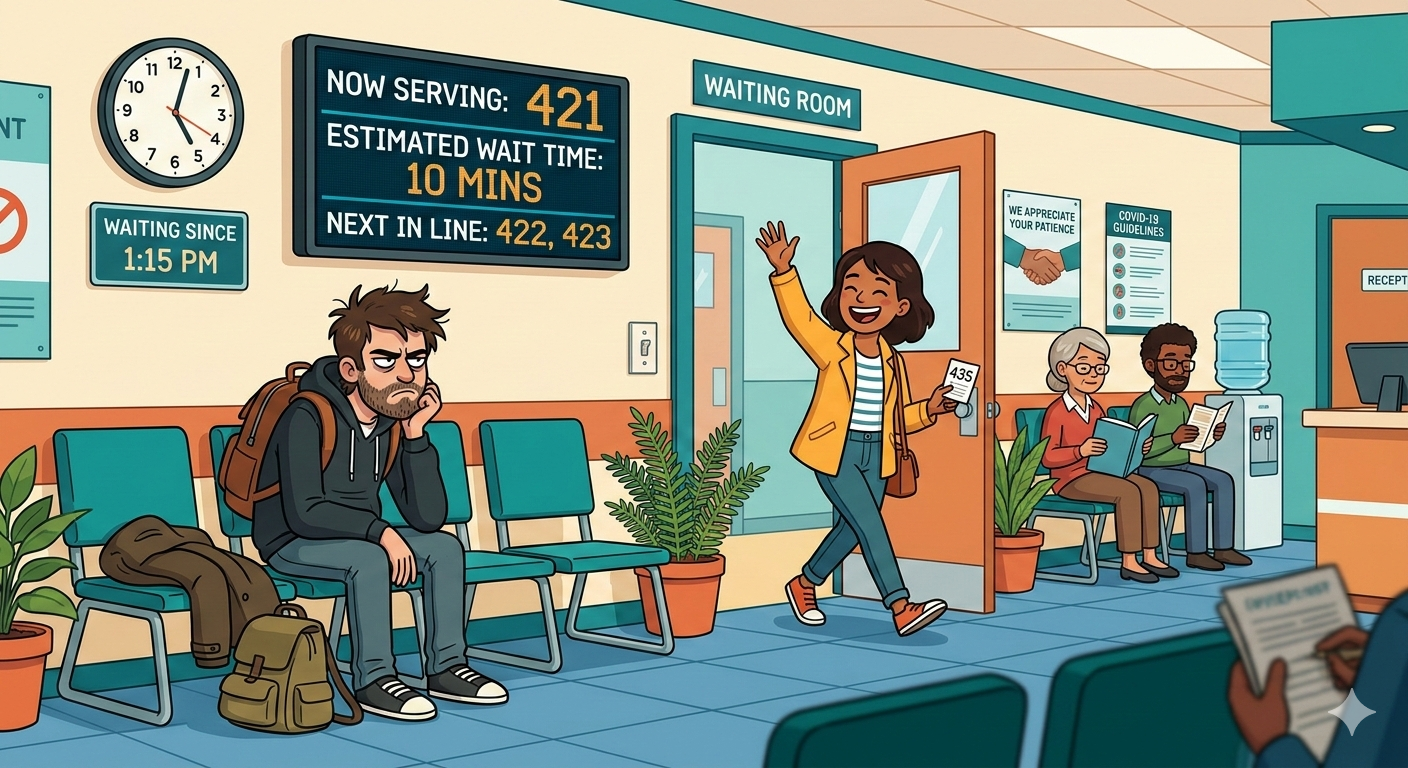
I spent my birthday afternoon in a hospital waiting room. Not because I was sick, but because my mother-in-law was. While waiting, I kept staring at the hospital dashboard, trying to understand how the average waiting time for a particular urgency level could show two hours, when there was already some persons who have been waiting for seven.
That gave me a particular kind of frustration — not from being misinformed, but from being informed incorrectly.
The Waiting Room Paradox
Imagine you arrive at the emergency room and the screen shows an average waiting time of one hour. Then, ten minutes later, a wave of new patients arrives. You glance at the screen and the average has dropped to thirty minutes. Has anything actually improved for you? No — you are still the same person, in the same seat, having waited the same amount of time. And yet the number went down.
This happens when the average is calculated by dividing total accumulated waiting time across all patients currently present, including those who just arrived and have waited zero minutes. Each new arrival dilutes the average, dragging it downward regardless of how long existing patients have been sitting there.
Why This Is a Problem
Statistics are only meaningful when they measure what they claim to measure. A patient reads “average waiting time” as how long I should expect to wait — but what is actually computed is closer to the average time all people in this room have spent here so far. A fundamentally different question.
The consequences are real: a busy influx of new patients will actively lower the displayed average, creating the illusion of efficiency at the exact moment conditions are getting worse. And when patients notice the disconnect between the screen and their experience, they stop trusting the information entirely — which is arguably worse than showing nothing at all.
The Right Way to Do It
A meaningful estimate could simply use the average time it took the last few attended patients to be seen from arrival — a trailing average that reflects actual throughput and is immune to distortion from new arrivals. Complementing this with the total number of people currently waiting would give patients a much clearer picture. Imperfect, but honest.
The Broader Lesson
We live surrounded by dashboards, averages, and indicators — in healthcare, in politics, in economics. Learning to ask what exactly is this number measuring, and does that match what I need to know? is one of the most practical forms of critical thinking available to us.
Statistics can be crafted to inform, but also — deliberately or not — to comfort, to impress, or to conceal. Knowing the difference starts with asking what, exactly, is being measured.
This post was drafted with the help of an LLM — the frustration in the waiting room was entirely my own.
The question is, is it stupidity or malice? Or neither? Maybe it’s just what we Portuguese call “chico-espertice” :D